Sunday, 15 May 2011

Plans for the Summer....

As you may have gathered I'm getting increasingly revved up for the summer. As well as my fitness plans, I'm heading out to Seville for a long weekend in early June and I'm already planning a massive blitz on writing. I've certainly got a lot to do; I want to make major inroads into writing new stories for The State of the Nation (I'm thinking particularly of ‘The Staggering Adventures of Bulldog Carruthers’, the ‘Nanny Knows Best’ top and tail stories, ‘They Came from IKEA’ and the new, as yet untitled, Elvis story) but I also want to polish up ‘Shooting Stars’ and ‘Dawn Of the Brain Dead’ and rewrite/polish ‘Keeping up with the Kingstons’.

I also want to start getting things in circulation again re: submitting to magazines and anthologies, particularly ‘Shooting Stars’ and ‘Dawn Of the Brain Dead’ as well as a number of short flash fiction pieces/sketches which are going to be interspersed between the stories in a Little Britain-style "roving eye across Britain" manner, so that one story ends then leads into a sketch which then leads into another story. I've got ideas for three, possibly four, of these; I just need to write them. I'm hoping that as they are all only around 500 words or so it shouldn't take too long to write these and get them into circulation amongst the flash fiction markets. The only thing which concerns me a little about these is that the ideas and tone of these are quite reminiscent of some of Chris Morris' Jam sketches (although that's probably not a bad thing) so I have to be careful that they are original pieces which fit into the whole, rather than leaving myself open to accusations of being a copyist (although I'll be avoiding expressions like, "Quadraspazzed on a life glug," so that should help.....).

On top of all that, I also want to polish and submit the radio play, First Love, Last Love, and if I have time, adapt the script into prose, nominally for the third collection which I'm currently calling Odds and Sods (although this is just a working title, as yet).

So all in all, a hell of a lot to do, even in a four-month break. However, I haven't been this excited about writing for a long time so I really hope I can make some progress here.

P90X


Due to increased levels of porkiness I have recently been re-evaluating my fitness program. In past years, I've always hoped to use the long summer holidays to lose weight and get in shape although I have always been frustrated in this for some reason or other. Last year it was because I was so busy (in June I was conducting oral examinations for Cambridge ESOL, in July I was marking written papers for Cambridge ESOL, in August I was writing a 7000 word dissertation for my dyslexia qualification and then in September the number of DSA needs assessments I was asked to write suddenly increased). In the couple of years prior to that, I was generally thwarted by poor weather; it is only when you wake up every day for four months hoping to do things outside that you realise how poor the weather is in this country. I really couldn't believe that I had 16 weeks off and I was only able to go outside for five or six days in all that time.

Anyway, this year I'm determined things will be different. I finish work at the University in two weeks and I've turned down a short-term EAP Lecturing post at the University as well as all oral examining work. In addition, the assessment work seems to be drying up for the summer and I hope to get any remaining work on my MEd done before I break up. I've still got some written marking to do, but this is pretty much flexitime so it shouldn't affect my ability to work out too much. In addition, whilst the Met Office is saying we are going to have a boiling hot June and July, I know from past experience that they can't be trusted so have invested in a variety of tools that will enable me to work out at home, even if the weather is dire outside and I can't do my preferred option of long cycle rides in the country or three hour power walks.

So basically, I have the time and I have the opportunity to make a difference. However, while I may be late to the game, I have also discovered the well-known workout regimen known as P90X and have been acclimatising myself to its demands by doing the odd workout here and there in preparation for the summer. Now, on a lot of the forums on the web, P90X gets a hard time for being "an infomercial workout," something for idle couch potatoes to do for a few weeks before the DVDs and equipment start to gather dust in their living rooms. Now obviously I hope to update this blog by the end of the summer with some excellent photos of myself looking godlike. But before that, I'd just like to express some initial thoughts on the programme.

P90X is a workout program that is spread out over 12 DVDs and which is based on a six on, one off weekly schedule, with three of those workouts being resistance based (usually body weight). In addition, the program changes every month so that over the 90 day period you do three different workout cycles, comprised of different workouts. On top of that, each individual workout involves doing a wide variety of exercises for each muscle group where the same exercise is rarely repeated twice. This is one of the key things about P90X, the well-known "muscle confusion" that is used as a major selling point of the programme (more on that later). It is also very fast paced, with very little rest periods between exercises. For example, the first DVD, Chest and Back, involves a round of something like 12 or 13 sets, repeated twice, with only 20 or 30 seconds between exercises, the idea being that your chest muscles are recovering from the chest exercise while you are performing a back exercise. Essentially, it is thus little more than an interval based circuit training programme.

However, while I have found it difficult to maintain a decent fitness schedule (hence the porkiness) I have managed to keep up to date with my weight work and so am pretty strong when it comes to press ups and pullups (the two exercises which are the mainstays of much of P90X’s resistance work). That said, when I first tried the Chest and Back routine I was huffing and puffing like a steam train and only managed to complete one round of the workout. It was then that I realised what the key strength of P90X is. It isn't the muscle confusion principle that they spend so much time selling; it's the fact that each resistance workout is essentially a cardio workout, too, albeit one that relies on using resistance. I can easily see why so many people who work their way through P90X end up losing so much weight despite their only doing three cardio workouts a week; the resistance workouts themselves are great cardio.

I've seen a lot of people on the Web also say that P90X may be good for general conditioning and fitness, but it's no good for building muscle. I disagree here; you can easily tailor the workouts so that you are using heavy weights to reach failure at 8 to 10 reps. Also, I defy anyone to prove that doing multiple sets of chin-ups, heavy rows, and heavy shoulder presses is not going to do anything in terms of muscle. True, there is a price to be paid for the short breaks between sets, and anyone hoping to turn into the Incredible Hulk would be better off resting for three minutes or so between exercises so they can work as hard as they can on their sets. However, I like the short rest periods and would rather have a resistance-based cardio workout than the sort of "mass building" workouts I've been using in the past. There is clearly a balance to be reached here however, and I believe that good form, focus and heavy weights will enable me to get the best of both worlds. Certainly, I've been a sore as hell after each of these workouts.

That said, I do have a number of criticisms of P90X so far. Firstly, looking at the workout schedule I do think it would be very easy to become overtrained. For example the first monthly schedule involves working (if you use Monday as day one) Chest and Back on Mondays, Shoulders and Arms on Wednesdays, and Legs and Back on Fridays. To me, this is overtraining. By Wednesday my arms and shoulders are still aching from Monday's workout so hitting shoulders and arms on Wednesday is totally counter-productive. Similarly, working back again on Fridays after completing a full arm workout on Wednesdays just isn't allowing enough time for complete recovery. So I have tweaked the workout a little to change it into a one on, two off schedule whereby I do two days of cardio after each resistance workout instead of the prescribed one. In addition, as my main issue is losing weight, extra cardio can only be a good thing.

My second criticism is that some of the exercises are a little "faddy" or are not as effective as they could be for hitting the specified body part. I think this is partly due to the fact that the workout is aimed at people who aren't hard-core gym rats and partly because they are desperately looking for different exercises to do so that the muscles can stay "confused." However, while there is an element of truth to muscle confusion, I believe that is more than dealt with by changing the workouts on a monthly schedule rather than doing faddy or ineffective exercises as part of a routine. So again, I have made a few alterations to the programme so that, for example, in the Chest and Back workout when it comes to doing an exercise called ‘Heavy Pants’ I do heavy dumbbell rows instead. Similarly, instead of doing diamond push-ups, which I regard as more of a tricep exercise, I just do another set of wide grip or incline push-ups or dips.

My final criticism of P90X is that it goes counter to some of the workout principles that I know work. For example, in the second month, the workout schedule changes to Chest, Shoulders and Triceps on Mondays, Back and Biceps on Wednesdays and Legs and Back on Fridays. Now while the push/pull workout schedule is something I've used for a long time, the P90X routines, because of their interval-based, circuit training nature, involve alternating back and biceps exercises or chest and tricep exercises in their respective workouts. This just seems wrong to me. How can you be expected to fully work the bigger muscles such as back when you're also working out smaller muscles like biceps at the same time? This essentially turns the pre-exhaust principle on its head and I don't like it. So when I get to those particular DVDs I've already planned to skip over the biceps exercises and do all the back exercises one after the other before finally doing the bicep work at the end. This is the way I usually work and it seems to me the best way of avoiding failure on back exercises simply because you've weakened your biceps. This is something that P90X’s mastermind, Tony Horton, has apparently already worked out as his follow-up to P90X follows the same schedule of hitting the bigger muscles first.

That said, despite these criticisms I am impressed with P90X so far. Despite some of the exercises being a little pointless I have discovered a few good new ones (such as Pike press) and I do really love the circuit training nature of the programme; you can have a great workout in under an hour at home. In addition, they are definitely hard - my heart is pounding like a jack hammer when I finish and despite the short duration of the workout, I'm normally gagging for it to end. Tony Horton himself is the guide to each workout and despite initially seeming like a typical overenthusiastic American fitness-type, he's actually quite likeable in an over the top, "Let's bring it!", kind of way.

I'm looking forward to finishing work and getting started on my new routine although again I have had to tailor it slightly in other ways. For example, I've had a little trouble with my right knee recently which means that the Plyometrics X DVD is out of the question for the time being. In addition, I doubt very much if I'll be doing the Kenpo X routine as it seems kind of pointless to me and I don't like the idea of skipping around in my house in front of the TV. As such, I'll probably be relying on DVD step workouts, cycling outside, power walking and stationary bike for my cardio. Yep, I have two DVD step workouts and a decent exercise bike (plus a hard-core spinning DVD that seems to be hosted by American Psycho's Patrick Bateman - he really is seriously sinister - you get that feeling that if it was up to him he'd put all people with a BMI of more than 20 in some kind of Concentration camp in deepest California somewhere) so that even if the weather is dire I really have no excuses for not doing anything this summer.

Now I'm off to, as Tony Horton is so fond of saying, "Just hit Play" .......


I'll keep you informed.


UPDATE:

Here is the Spinning guy. It's a seriously hard workout, but it's hard to stay focussed with Mr Aryan creeping you out the whole time. You almost expect him to start extolling the virtues of Huey Lewis and the News before pulling an axe from the back of his bike.

Sunday, 17 April 2011

The annotated Ugly Stories for Beautiful People - BobandJane


BobandJane - A Fable in Two Indistinct Parts

Originally Published in Raw Edge 4, Spring/Summer 1997, ed. Dave Reeves


Well, as promised, here is the first entry of the Ugly Stories notes. Initially, I was unsure of where to start as some of the stories do have quite a lot of back story to them whilst others do not. However, for the sake of convenience, I've decided to, in the best storytelling traditions, start at the beginning.

So, “BobandJane”.

It's hard to remember exact dates but I think “BobandJane” was written in the late spring/early summer of 1996. I'd returned from Barcelona in the February of 1996 in a pretty bad way. For reasons that should be apparent to anyone who's read the Ugly Stories I'd pretty much had a nervous breakdown in the November/December of 1995. I'd soldiered on for a few months, trying to make the best of a bad situation and ignore what was happening; I'd continued to go to work teaching ESOL to Barcelonese businessmen; I'd tried to lose weight by walking to all my appointments, sometimes walking up to four hours a day; and I'd started writing again, rather than simply developing plot outlines or noting down new ideas (something I had been doing for the previous 12 months because basically, I was too fucked to do anything else).

One of the standout stories of that period was “Fragments of a Schizoid Dream” (more on that later). However, in late February 1996 I returned to the UK and, incapable of looking after myself, I moved back in with my parents. The rest of that year was a strange blur. I really can't remember much of anything that happened at that time. However, strangely, it was a very productive time. With the distant hope of becoming a Lecturer in English literature I had enrolled with the Open University to study for a second degree in English Lit (my first was in Psychology), taking half a degree per year. In that brief 12 month period, I also wrote over half of the Ugly Stories for Beautiful People and, as I was unable to sit still without my thoughts becoming overwhelming, I continued to walk for several hours a day around the local countryside and canals getting into possibly the best shape of my life. Oh yes, and somehow I also managed to work full-time in a local petrol station (the only work I could even consider doing at the time, although this too was important for a number of later stories - again, more on that later).

In some ways “BobandJane” is a classic example of how my mind works when it comes to the process of developing stories. It started with a simple observation that, in my previous relationship, several people had said we were (unfairly, I thought) "joined at the hip." Quite simply, I'd just extrapolated this everyday phrase into the literal; what if a couple was so in love that they literally were joined at the hip? At the same time, however, I also noticed that many of the couples I knew had just disappeared from my social scene; it's that old cliché of people disappearing until they split up again. I also remembered how annoyed I was at receiving Christmas cards addressed, not to me, but to me and my girlfriend. It was as if we had become one person, one blob..... and so “BobandJane” was born.

“BobandJane” was also a strange story in that I usually outline and develop stories in great detail before finally writing them in over a period of a week to a month, usually writing 1000 to 2000 words a day. “BobandJane” was different in that once I had had the initial idea and had thought of a number of key lines and scenes, I wrote it in one sitting and the first draft was essentially the finished draft. I usually spend a long time editing, revising and even sometimes rewriting stories. With “BobandJane” I simply polished it a little and cut out some of the flab; it was virtually 90% finished once I had finished writing the first draft.

“BobandJane” was also the first story I had published. Prior to that I'd had a few haikus published in small press magazines and some embarrassingly Baudelairean prose poems published in tiny literary magazines. However, Raw Edge magazine published “BobandJane” in their fourth issue and it appeared in the spring/summer of 1997. Raw Edge, like many magazines, is no longer with us but it was a great showcase for new writing talent and was subsidised by the British Arts Council. As such, it was distributed to local libraries and had a circulation of over 16,000. It also had great production values with thick paper and glossy covers. In some ways, my writing career came full circle with Raw Edge; “BobandJane” was published near the beginning of its life and a review of Ugly Stories for Beautiful People appeared in its very last issue.

So, “BobandJane” was one of the first stories I wrote (probably the sixth in total, but only the second or third once I had discovered my voice in Barcelona), was the first story I had published, was the first in a series of "body horror" stories (the others being “It”, “The Byronic Man,” “Foetal Attractions” and an unpublished prose poem called "If Janus Had Two Faces, Then Why Can't I?"), and was probably the first story I realised I could use to integrate and interlink a number of the Ugly Stories, something I wanted to do from the beginning. As such, it seemed right that it should be the first story in the collection. Once I had realised this, I knew I wanted a "top and tail" story as I had been a fan of this way of opening and closing collections since I had read Clive Barker's Books of Blood and Ray Bradbury's The Illustrated Man in the early 90s. (Although bear in mind only around 10% of the collection had been written at this point, although I had a full listing of the stories I wanted to include in it at this point). Thus, the “BobandJane” postscript was written quite soon after the original “BobandJane” story, although I cannot remember exactly when; however, I suspect it was written after “BobandJane” had been published in Raw Edge so it was probably sometime in 1997.

“BobandJane” also gave me my brief first taste of "fame." I remember ringing West Midlands Arts to enquire about jobs in arts promotion and, when I gave my name to the guy on the other end of the phone, he said, "Oh, you're the “BobandJane” guy." Not exactly like being asked for an autograph in the street, but to a virtually unpublished writer such a small scrap of recognition goes a long way.

“BobandJane” is also the only Ugly Story I have ever performed live. The video can be found here. And while the print version of Raw Edge is long gone, the website still has a copy of it here. Hope you enjoy it.

One other strange thing I've noticed about “BobandJane” is that everyone who knows me and is part of a couple (and I mean everyone!) seems to think it is about them. I don't know why; it really was a reflection on my own experiences of being in a relationship at the time and wasn't based on anyone else. In some ways it's flattering that it seems to resonate with people. In other ways it's incredibly sad that people can, or would even want to, identify with them. Now I personally identify more with Kokoschka in the story and in some ways it was a pleasure to liberate Jane and open her eyes in the Post-Script, as Will in “The Dada Relationship Police” was very much based on me at the time. It was undoubtedly satisfying to be the one who handed Jane the Dada Relationship Police card, saying “Your relationship is over!”.

Monday, 28 March 2011

The Annotated "Ugly Stories"


Just a "treading water" post, really. As the Summer gets nearer and the prospect of no longer doing 14 hour days but instead having 3 months to do nothing but write gets closer, I've been thinking more about the "State of The Nation" stories. Most, if not all, of them are satirical pieces and, as with most speculative fiction, they involve taking something in the present (usually something that annoys me) and then exaggerating them to the point where you can get a story out of them to highlight the stupidity and mendacity of what is going on. Indeed, many of the stories (concerning as they do, the loss of civil liberties, the Nanny State, Political Correctness, celebrity culture etc) don't even need exaggerating! As a result I was going to put in footnotes and references to every example used in the stories just to show that the examples were real - yes, they are happening now, and here is the report that proves it! However, I soon realised this would probably jar and ultimately interfere with the flow of the stories. They could also probably irritate some people who would rather pretend that they were "way out there" satire rather than events that are happening now.

So, when I finally get the stories together (which may be a while - I seem to work at a glacial pace...) I'll be uploading the relevant references and annotations here, so if people want to see them they can. However, that made me think about the "Ugly Stories" and about how much I loved one thing about the mid 90s UK reprints of PKD's collected stories. At the back of each of the five volumes were a few pages of notes by the Great Man himself - excerpts from interviews where he talked about the story and how it got published, or notes culled from earlier collections where he wrote about what inspired him to write the story, how it was received, what was going on at the time he wrote them. I loved these notes (an early version of the Director's DVD Commentary, I suppose) as they let me know more about PKD in those days before Lawrence Sutin's definitive biography came out. From these notes I found out about how one morning he woke up to find twentysomething rejected manuscripts on his front porch. I learned about those apocryphal tales of Berkely living in the 60s, of the dark-haired girls he invariably fell in love with again and again and again, of how he was so poor at one point he and his wife were reduced to eating dog food.

So, in the same vein, in the next week or two I hope to do a similar thing here. Go through each story in the collection giving a bit of background info to what inspired it, who published it, the reception it received. How I felt about it at the time and how it shaped me as a struggling writer. I don't want to put such things in the book itself (no matter how much I loved the notes in the PKD collections) but if people want to learn more about the stories then they will be here to look at. I hope to put the first few notes up this week, workload permitting....

Tuesday, 1 March 2011

2-3-74 According to Robert Crumb


Don't want to keep focussing on PKD (Blessed be his name!) but here is something I'd never read before although I'd seen the odd panel. Robert Crumb's 8 page telling of PKD's transcendental experience/breakdown(* delete as applicable) in 1974, something which Dick himself dealt with (in depth!) in his "Exegesis" as well as in his later novels starting with the brilliant "Valis."

Read it here.

Saturday, 19 February 2011

PKD - speeches and interviews.

I've always dug the fact that Dick's transcendental 2-3-74 experience covered my 3rd birthday. In fact, booksfactory.com actually names my birthday as a specific date in this pivotal period - "On March 22, 1974, he had a transcendental mystical experience, which he described as "an invasion of my mind by a transcendentally rational mind." This experience caused Philip K. Dick to begin recording his thoughts and experiences into a journal, which he referred to as the Exegesis. The Exegesis contained a phenomenal amount of Gnostic religious thought and philosophy. The majority of his experiences and philosophies formed during this period can be found in the VALIS trilogy", which includes VALIS, The Divine Invasion, and The Transmigration of Timothy Archer. An alternate accounting of the events of Philip K. Dick's VALIS encounter can be found in more accessible form in the novel Radio Free Albemuth, which was discovered among Dick's notes after his death, and in which the main characters have reason to believe that their everyday reality is actually the Ancient Roman Empire during the persecution of the early Christians."

Okay, pathetic I know, but some people play Dungeons and Dragons, others like Rugby or memorise their favourite football teams. I take pleasure from having my 3rd birthday be a pivotal point in the great mind of PKD.

Anyway, let's put my eccentricities to one side as I present a few rare gems. Dick didn't do a lot of TV, so enjoy!


Extracts from first draft of "Keeping Up With The Kingstons", from "State of the Nation."


A first draft, so I know it's a bit ropey in places. Still, it's got some nice images in it and an ending that doesn't involve madness or death, so something of a first. Although it does involve a relationship breakdown, so perhaps not too much of a departure from the norm. Anyway, this was written around the same sort of time as the "Ugly Stories" but I felt it didn't fit in with that collection which focussed mainly on love, reality and how love can alter reality. However, it does fit in with the underlying theme of "State of the Nation" so, almost ten years on (and after being accepted for publication by the long-gone mag "Sierra Heaven", although they went to the mag graveyard in the sky before actually publishing it) it's now nominally part of that collection. Surprised it was accepted though to be honest. It's definitely a first draft and needs radical revision, if not wholesale rewriting. Then again, I suppose given my current work schedule that's what the Summer is for.

It's also strange to see how things change, even over ten years. For example, I described the "Colour Cube" as being "as big as a TV set." Yet now all TVs are flatscreens that piece of description is pretty much irrelevant. Inaccurate anyway, given that it's a Cube. He also reviews the "Kingstons" show on video tape. This is a bit trickier now we all have Hard Drives and Plus Boxes, expecially given what he does with the video tapes at the end of the story... not exactly possible with an mp4 file. Still, it's an old show - I can always say he started his Kingstons collection on video. And in some ways, given that the whole point of the story is his adopting a non-conformist, non-materialist, "anti-consumer" lifestyle, I suppose his preference for outdated technology because, "Hey, it still works so why throw it out!" does actually make sense, in a way. In some ways that can even be an advantageous thing; something that adds to his characterisation.

Anyway, a few extracts from "Keeping Up With The Kingstons." It might be fun to see how this changes and develops as time goes by.


"I had been a fan of "The Kingstons" in its early "wobbly walls" period, but what with everything that had happened over the past few years I'd lost interest. It had started as just another slightly kitsch family melodrama until the Late Noughties when Sir Harvey Williamson was appointed as Executive Producer and storyline consultant. An MP who had made his money in Marketing and the Media, Williamson was a powerful force behind the show, and the ratings skyrocketed almost overnight. Children watched it in their school lunch-hours, workers rushed home in time to see it, and the BBC even changed its third weekly broadcast from Friday to Thursday night after the Breweries complained that people refused to go out until after it had finished. And so the phenomenon known as "The Kingstons", the most popular TV programme in British viewing history, reached its fifteenth birthday.
However, as I looked at the bare plan, I started to seriously wonder if I could really write 8000 words on the thing. I'd easily written a similar article for the "Eastenders" thirtieth Anniversary the year before, despite hardly ever watching the show. The drug abuse, incest, arson, unwanted pregnancies and so on, easily lent themselves to an interesting article. But "The Kingstons"? In fifteen years of occasional viewing I couldn't really recall anything of interest that had actually happened.
I heard a knock at the front door, and looking at my watch realised that it was another of Sophie's deliveries.
I opened the door, the unshaven man thrusting a bitten pen and a clipboard at me to sign. Resignedly, I wrote my name, and the man grunted and walked away down the path past the weeds and empty crisp packets, casually discarding a cigarette in the garden as he left.
In front of me were two brown cardboard boxes, one small and relatively flat, the other as large as a T.V. set. I knelt down and picked them up, the large box surprisingly light. I kicked the door shut with my heel, and carried them through to the kitchen, where I carefully slid them onto the table. The small box was indeed a new video, and, as I'd thought, it was exactly the same as the previous one except this was a TX100 j, the "j" obviously making all the difference.
However, on opening the larger box, I was amazed to find a large plastic cube. It was hollow, and its upper surface could be removed, but as far as I could tell it had no function. I looked at the invoice to see if that could tell me what it was, but it simply said "Colour Cube tm".
And then I saw the price.
At £995 (not including VAT), it couldn't simply be a red plastic box. But, that was all it seemed to be. There were no wires, cables, or electrical components, and its box didn't contain a manual.
I lit another Marly, and sat down staring at it, as I pondered what it could possibly be."


[...]


"Nothing you see on television is actually there.
All those blue-rinsed old biddies who worry about all the sex and violence, the bad language and lewd behaviour, they all miss the point.
It's not really there.
It's just thousands of dots; blue, green, red dots all blazing away, a new pointillist work created every microsecond, an abstract image forming again and again and again.
And that's why you had to admire "The Kingstons". Because, despite its crassness, its one dimensional storylines and cardboard characters, it somehow managed to create out of this swirling mass of technicolour a world that was almost obscenely black and white. Wealth is good, poverty is bad. Beauty is good, ugliness bad, and so on and so forth. The possibilities dormant within the maelstrom of colour, the beauties that could be shown, seemed to be ignored in the chrome-and-money world of "The Kingstons".
But then again, it's not really there so why worry?
And as I argued with Sophie, for the second time that day, I had a disturbing glimpse of the world in which she lived. I was poor, weak, and holding her back from the materialistic joys and excesses which she could see just lurking over the horizon of her future. In Kingstons-speak, I was poor, I was weak..... I was bad.
And as I sat watching the T.V. after Sophie had stormed out, I thought about how I viewed our life, our relationship.
And it was then that I realised that I wasn't going to worry about it anymore, I was going to stop losing sleep over how I could get her to love me again, or how we could be happy with each other again.
Because our past love, our happiness, our whole relationship was much like the flat fictitious images on the T.V. screen.
It wasn't really there.
And it never had been."


[...]


"Oh, you're still doing that", said Sophie, putting her head round the doorway as I lay on the floor typing. "I hope you videoed "The Kingstons".
I grunted.
"God, that's all you say to me now. I've met pigs who are more articulate than you."
"I didn't know "Harvey Nichols" sold livestock nowadays", I replied.
She curled her lips in disgust, and noisily dropped her briefcase in the doorway. I felt myself relax as she left the room and heard her lifting the cardboard boxes from the corner where I had left them.
I stopped typing for a moment, knowing what to expect.
An excited squeal came from the kitchen.
"What is it?", I shouted through to her.
"A new Colour Cube".
"Yes, I know, but what is it? What does it do?"
I heard her leave the kitchen before seeing her head around the door.
"It doesn't do anything. It's ornamental."
I sat up, perplexed. "Ornamental? A metre wide plastic cube? It's not even smooth. You can see where it's been moulded."
"Well, what does that ugly thing do", she said, pointing at my lamp.
I examined it exaggeratedly.
"I think", I said, "it gives out light. That's probably why it's got a light bulb stuck on top of it."
Her lips curled up again. "Don't be sarcastic. It doesn't suit you." She picked up her briefcase and stomped upstairs. I heard the bedroom door slam, and took a deep breath before returning to work.
Realising that most viewers probably had as much difficulty in remembering the early episodes as I did, I had decided to focus on the more recent ones.
However, as I fast forwarded over a six month-old confrontation between Crispin Kingston and his sister Sophie, something caught my eye. I stopped the tape, rewound it slightly and then played it.
It was on the screen so fleetingly that I had to rewind the tape again in order to pause it, but, there! Just as Sophie was harassing Crispin to leave University and get a proper job, I saw something sitting on the polished oak floor of their living room.
A bright red, shiny Colour Cube."


[...]


"I sat at the table, drinking another glass of red wine. Josh and Sophie's other friends were all pretty much as I'd imagined them, flash, pretentious and snobbish, and they sat around talking about "Sales gradients", and "ABC1 Purchasing Curves" for much of the evening.
My few attempts at humour were largely ignored, and after a while I actually found myself being patronised by them, feeling like Nora in "The Doll's House" (although I realised that they wouldn't be able to understand the analogy). I made a joke about seeing an advert for a miraculous new vacuum cleaner from the States called an "Ibsen", and chuckled to myself when all-mighty Josh said that he was currently trying to "work the UK end of their marketing network".
The others nodded wisely and wished him luck.
Indeed, in the three hours I'd been sat at the Hell-table, the only time their talk veered away from work was when they talked about their (expensive) holidays in Rio, Tokyo or Buenos Aires, and when Sophie announced, as if I'd been building a paper-plane, that I was writing an article on "The Kingstons". At this, all heads turned, and I admitted that I was but was unable to continue much further due to the crumbs from a particularly flaky vol-au-vent falling from the edges of my mouth. Their attention thus lost they soon started to discuss their Pension Plans, and I was again ignored.
I looked around the room seeking a quick escape route, and unsuccessfully stifled a yawn. It was decorated in the popular retro Eighties-style popularised by "The Kingstons" - black furniture, bare polished floorboards, silvery-grey rugs and plenty of chrome. Through the conspicuously open double-doors I could see into the living room, or "lounge" as Josh referred to it. It was small, but decorated in the same way. I could see the TV set and video (a TX 100j), the frosted glass door of the video cabinet obviously left open "accidentally", and the various Waldo-like lamps designed by "Aldi of Paris", nestling next to "Ceero" ("Of Barcelona, incidentally") sofas and chairs.
I turned to Sophie who was also looking around the room like a vulture hovering over its prey, obviously comparing their possessions with our own, and, judging by the barely disguised look of annoyance on her face finding ours lacking.
Readying myself for another rash of indiscriminate shopping, I asked where the toilet was, to be told that the "loo" was upstairs, and so flashing a cursory grin at the company (which was ignored) I stood up and left the table.
As I closed the door behind me, I took a deep breath and willed myself to relax. I climbed the stairs, fashionably polished with a thin strip of thick ethnic-style carpet running up the centre, and went to the toilet. I decided to wait in the toilet for a while, to give myself time to "gird my loins" for my next confrontation with them.
As I sat on the toilet-seat, surrounded by a confusing mix of "English Country Cottage", "New York Minimalist", and "Amazonian Ethnic" ornaments and hangings, all fashionable but tastelessly thrown together, I thought about them all chattering downstairs. I'd always hated that sort of person, and until recently so had Sophie, and that was what I found so hard to understand. If anything, it was Sophie's contempt that had rubbed off on me, yet here she was smiling, giggling and flirting like a sixteen year-old. It was understandable why everyone seemed to like her so much, but I just wished they could catch her unawares at home and see what I had to put up with.
The lack of overall design in the room, a hotch-potch of designer items, clashing and contrasting with each other, reminded me of people who dressed in mink-coats and Armani jeans, thinking that the "label" somehow compensated for the appalling overall look.
I could see from the minimalist black-and-white wall-clock - was it normal for me to know the prices of almost everything I could see? - that it was time for me to rejoin the others. I flushed "the loo" and walked back out onto the corridor.
However, as I closed the door, another slightly open door at the end of the corridor caught my attention, and before I was fully aware of what I was doing I was standing outside it. It was painted gold with the familiar "Ikea" May range of Aztec symbols stencilled on it, but it was what lay behind the door, almost hidden in the darkness that caught my attention.
Stealthily, and checking that no-one was leaving the dining room, I opened it and turned on the light.
The bare bulb lit everything with a harsh glare. Although perhaps everything was too strong a word, for the room, while large, was almost completely empty. The floor was uncarpeted, and covered in a thin layer of saw-dust, and a large crumpled mattress lay by the far wall. The walls too, were bare, the mucky plaster adding more to the Aztec motif than I was sure Josh and Charlotte intended. Next to the bed were three large cardboard boxes, full of crumpled designer-clothes, Armani, Gasper and McQueen, and yet that was all. No trendy objet d'art here.
The only part of the room which was in keeping with the dining room, living room and toilet were the drawn curtains, which were the latest designs from "Romanoff's".
Smirking, I discounted moving something so that Josh and Charlotte would see that I knew their secret, and left the room. I opened the door to the other bedroom that was at the top of the stairs, this room too being utterly bare and undecorated. There wasn't even a mattress. Then again, I thought, any guests they may have could be easily put-up on the latest futons they had littered around downstairs.
Downstairs in the rooms where we had been carefully shepherded.
I opened the living room door, and noticed that everyone had finished their Brandys, and were milling around the rooms, admiring Josh's taste in furnishings. As Josh proudly announced that he was having a conservatory built, I found Sophie examining the underside of their Colour-Cube, this one blue, in the living room, hidden from my previous vantage-point by the sofa. She turned to me.
"1003 B", she said.
"What?"
"1003 B", she repeated. "Ours is 1059 R. Theirs is newer than ours. We'll have to get another one before we invite them to ours."
And so saying, she delicately placed the Colour Cube into its previous position, and, broad smile fixed on her face, went over to talk to Josh about the merits of conservatories in inner-city "living spaces".

Friday, 18 February 2011

Extracts from "Shooting Stars" - from "State of the Nation."


" They say we’re living in an age of Celebrity. Celebrity with a capital “C”, because it’s important, not just “celebrity” as in “being known”, but “Celebrity”, because that’s really the thing to strive for. Who cares about the chap who cures cancer or feeds Africa or brings peace to the Middle East? All that matters now is getting your smug face on the telly, filling up the column inches with your non-activities and non-achievements.
And I suppose in a way I’ve colluded with this, writing about the celebrities when they’re dead and buried, outlining the travails of their lives, their highs, their lows.
It used to be that I’d write obituaries about real people; people who deserved to have their lives celebrated. The kind of chap who at 21 had already earned a Victoria Cross for single-handedly storming a Nazi gun emplacement, before rowing the Atlantic at 23, becoming CEO of ICI by 25, then raising a handful of children and acting as a senior consultant to the likes of Wilson and Nixon in his twilight years. Yes, in those days “Celebrity” didn’t really exist. There were stars of course, but they had real glamour, and were few and far between - Monroe, Garbo, Bogie. Yes, those were the days. I remember as a younger man, reading about Buddy Holly’s dying. Ten lines it got. Ten lines. On page seven.
Now, the fact that Jodie Marsh can get out of a taxi without any knickers on is front page news.
Still, who can blame all the youngsters and slack-jaws for worshipping Celebrity. It pays, after all, and pays well.
Look at Dale Winton’s townhouse, for example. Three stories of marble, polished oak and Feng-Shuied designer interiors in the centre of Belgravia, and this the fruits of the labours of a man with no discernible talent, save that of looking uncomfortable on millions of television screens.
And of course, he let me straight in. I looked the part, blue overalls, a blue baseball cap with “Sunbeds of Knightsbridge” embroidered on it. And of course, despite decades of writing incisive summations of people’s lives and work for The Telegraph, he didn’t recognise me. After all, I’m not a Celebrity. I’m not on the telly.
So he let me in, and left me to my own devices. I had worried that I’d have to be particularly stealthy, but he just showed me the room and left me to it. I couldn’t believe how easy he was to fool; he swallowed my story of his sunbed needing a service hook line and sinker. After all, what does he know about real things, important things? What does he need to know? Probably too consumed with discussions with his PR people, his agents and the latest viewing figures.
So I went to work, and took my time about it. The latex gloves made it a bit more difficult, but it didn’t take long for me to remove the plastic base, and get to the workings of the sunbed itself. You see, all sunbeds have a timer mechanism on them. Normally around twenty minutes, but Winton had one of the new super-powerful ones with a six minute timer. All it took was a quick snip snip, and half the job was done. Once turned on, the sunbed could only be turned off by pulling the plug out of the socket, something which was impossible from the bed itself. Which brought me onto the second part of the operation, and the most problematic. I’d toyed with the idea of bunging up the hinges with plastic padding or silicon, but he would’ve noticed that as soon as he tried to shut it. Finally I settled on taking the hood off the bed, then filing two slots into both of the hinges. He’d be able to close the lid okay, but once it was fully closed the two bits of filed metal would catch on each other and the hinges would be locked, and he’d be stuck there, slowly frying under the never-ending UV light.
I suppose these deaths are a bit melodramatic, but perhaps that’s just the writer in me coming out.
But whatever, in thirty minutes I was done, the idiot paid me, and I was on the coach to Brighton within the hour, his obituary already half-written in my head.
Winton kicked the bucket that night, by which time I’d been booked into my hotel room for several hours. The obituary was already on my laptop, and by the time Marcus had tracked me down to commission it, I had the, “My God, that’s awful. Who could do such a thing?” act down pat.
But that’s one of the sad truths about celebrity. I was making more money writing about these microcephalic nobodies than I was writing about true heroes, people who made a difference, who actually did something. Because there wasn’t just the obituary itself. Oh no, for some reason these people merited multi-page feature pull-out sections, with colour photos. So I did those too, and was now making a pretty penny.
More than enough to buy a new car, anyway, although I had been waiting until I could sell my old one before I did that, something I couldn’t do until the heat had died down. I’d cleaned the blood and bits of torn cloth and tissue from the radiator and bumper, but what with everything they can do with forensic science nowadays, I didn’t want to take the risk of taking it to a garage.
And I suppose in some ways I’d formed a sentimental attachment to the thing. After all, it marked the beginning in my change of luck; it was responsible for the upswing in my mood and fortunes."


[...]


" Yet despite the successes of my new hobby, the iniquities of the world continued. A writer of my genius can write a novel in only a matter of weeks, yet my latest opus was rejected by every publisher I submitted it to. One even had a brief letter attached, a first for me. Hoping that it offered constructive criticism, I read it quickly and was disgusted to find that the talentless illiterate who had written it had had the temerity to tell me to stop submitting my “rubbish” to them. Once my rage had subsided I re-read the manuscript for the first time since I had finished writing it, and was amazed that it wasn’t really up to my usual standard.
I had to conclude that my true talent was for killing, and that my writing was actually interfering with this vocation. So then, I put all my creative juices into my new occupation and my reign of terror hit a Golden Age, as the number of immolations, explosions, vomit-chokings and anorexia-related deaths boomed across the Capital.
But now, as I sit here, I can see where I went wrong. With my full creative genius focused upon this one end, my assassinations had become increasingly complex, if not downright preposterous, and that was to prove to be my downfall.
I had managed to wangle a ticket to the launch party of Jordan’s new book, from one of the sniffing, red-eyed hacks who worked on the paper’s Showbiz pages. It was held at some outrageously overpriced watering-hole in the West End, and despite wearing my best suit from Saville Row and waving my VIP ticket at the gorillas on the door, they deliberately barred my entrance to the club for almost an hour. Meanwhile so-called celebrity chefs, ex-Big Brother contestants and a stream of mediocrities from the nation’s soap operas streamed past. Finally, they deigned to let me in, as they had had their power game and the importance of my ticket could be ignored no longer. However, as you can imagine my blood was boiling at this point, and every smug fake-tanned face that walked past me was like something from those old cartoons where the starving character would see their friend as a walking hot dog or chicken leg. One had a noose wrapped tightly around his neck: another a drugged orange shoved into her ever-yapping maw. One had overdosed on pharmaceutical grade Viagra, his tool tent-poling out of his trousers like an angry purple truncheon, and another had died from fright after an overdose of LSD and Angel Dust meant that the very sight of the public that they had spent so many years blindly courting led to an intense bout of paranoia and a fatal anxiety attack.
But then I was roused from my reverie by the sight of my target. Jordan was sitting at a table surrounded by an entourage of sycophants, while beyond this circle a large group of stupid-looking young men ogled her ridiculously inflated breasts and nudged their friends with stupid leers spread across their faces.
I fingered the metal pineapple in my pocket, an item of military hardware which had proven ridiculously easy to obtain, once you know which Eastend boozers to go to, and which Paddy’s throat to lubricate.
I moved behind Jordan’s table, and even I was impressed by the voluminous size of her jugs. Yet they made my job easier. Inside my pocket I eased the pin from the grenade.
Yes, soon she would get her wish. Soon her tits would get so big they would literally explode across the room. And her complaint of everyone wanting a piece of her would prove to be painfully true.
I moved closer to her, eyeing the bosom that would envelop my gift to her, and then suddenly, swiftly, I lobbed the grenade down her cleavage, then pushed my way through the throng towards the exit. But one of her companions, probably some media-whore who wanted to prove himself to her, came after me and rugby tackled me to the ground. I fought back desperately, still only a few yards away from her. I could see her groping around her cleavage where the grenade had slipped down.
But as I kicked and screamed and struggled to shift her idiot friend off me, I slowly realised that it was taking its sweet old time to go off. The seconds stretched on and on and painfully on, and it was then that I realised that I’d been ripped off.
Of course, as it transpired I hadn’t been. The Police would have let me off, if that was the case. Just some harmless old eccentric lobbing toys around. No, that bastard bog-trotter hadn’t ripped me off. It was a grenade alright. Just a dud one.
And because of that the Police had gotten me, bang to rights.
And I confess, as I waited to stand trial, I did rue my own ingeniousness. Why hadn’t I just gone around shooting them? A bullet in the back of the head would have been so swift, so final. Why did I have to act like some kind of Bond villain? I mean, a grenade in her cleavage? What was I thinking?"

New Untitled story


A scene from the latest (as yet untitled) story from "State of the Nation"?


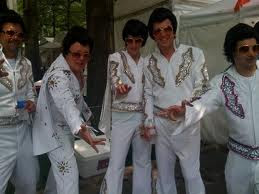
Yep, possibly. Let's just say that, like the rest of the collection, it's a satire on life in the UK today. There is a "concensus" on what constitutes true Elvisness, and woe-betide anyone who would postion themself as a "Vegas-denier."

Hopefully, I'll get the first draft of this done before Easter.

Saturday, 27 November 2010

Surrealism in literature - my take on it.


Many literary historians would define "surrealism" as "a Twentieth Century movement in...literature purporting to express the subconscious mind by phenomena of dreams etc", but I would like to present an alternative history of surrealism in Literature and demonstrate that it was more than a short-lived pre-War movement, but adapted and changed to become an intrinsic part of many contemporary novels by merging with many realist techniques, and indeed, is now more widely-read than any of the original movement's founders could have hoped. While the similarity of some of the works to which I will refer with the works of Breton and Bataille is minimal, few would argue that the contemporary novel isn't fundamentally realist in form even though they have little in common with the likes of say, Fielding or Stevenson.

While the surrealist impulse has been present in Literature from Hesiod (who claimed to be instructed by the Muses), and the poet-priestess of the oracle at Delphi, through England's first poet Caedmon (who wrote when possessed by the spirit of God), to the dream literature of Coleridge's "Ancient Mariner" and "Kubla Khan", Byron's "Fatal Man", and the descriptions of madness and irrationality in Shakespeare and Milton , the word was first coined by Guillaume Apollinaire in 1917, and the first truly surrealist work was Andre Breton and Phillipe Soupalt's automatic text The Magnetic Fields, published in 1919.

These early surrealists thought that automatism was the way to express the subconscious, expressing in Breton's words, "properties and facts no less objective" than those in the external world. Breton described how to write automatically in his Manifesto of Surrealism (1924), and thought its seemingly nonsensical phrases used the "grammar of dreams", a process very similar to what Freud called "condensation". In the Manifesto Breton said "Is it not possible that my dream of last night follows the one before, that dreams give every sign of being continuous?", a questioning of "objective" reality similar to that of two writers I will later discuss - Philip.K. Dick and William Burroughs (who once responded to the question of whether he believed in life after death by asking, "How do you know you're not dead already?")

However, by 1947 The Surrealist Groups in both Paris and London had dissolved, and in America literary surrealism, with the exceptions of Samuel Greenberg, William Carlos Williams and Charles Henri Ford, had remained disorganised and unfocussed, driven primarily by those European intellectuals and artists that had fled to America to escape the Second World War. Thus, the surrealist "movement", and surrealism itself, as accepted by many literary historians, fizzled out, and passed into history as an interesting experiment (although small numbers of surrealist writers continue to work today).

However, I would argue that surrealism did not disappear thus, but changed and moved into other literary sub-genres. The literary historian can see little evidence of it simply because he is looking in the wrong place.

Its history can be traced from the likes of Breton and Bataille in the Thirties and Forties, to the Beat writers of the Fifties especially Jack Kerouac and William Burroughs, and their work marked a significant move of the surrealist impulse and technique from a small, intellectual "avant-garde", into the mainstream.

Much of Kerouac's work was a "hip" stream of consciousness, and he believed in a form of literary Truth, which meant that, like Breton before him, he refused to change a single word once it had been set on paper. Burroughs (a former student of English Literature at Harvard), on the other hand, was probably the most overtly surreal of the three "big" Beat writers (Allen Ginsberg being the other). His focus on drugs and drug-induced altered states paralleled Breton and Dali's focus on dream-consciousness and paranoia, as well as mirroring those poets that the Surrealists admired, such as Coleridge and his opium-induced hallucinatory verse of "Kubla Khan".

While writing his most famous novel The Naked Lunch (1959), Burroughs was experimenting with mescaline and paregoric (an elixir of opium), and was reading psychiatric research on the effects of mescaline on schizophrenics. It was during this time that there was also a physical link with the early Surrealists, in that he met Man Ray and Marcel Duchamp, and was friends with Jacques Stern, (a friend of Dali and Jean Cocteau).

Much of the novel is set in "Interzone" of which Burroughs said in 1955, "the meaning of Interzone, its space-time location is at a point where three-dimensional fact merges into dream, and dreams erupt into the real world. In Interzone dreams can kill....and solid objects and persons can be as unreal as dreams." Similarly, he explains his method as:

"There is only one thing a writer can write about: what is
in front of his senses at the moment of writing....I am
a recording instrument....I do not pretend to impose
"story", "plot", "continuity".

Much of the book was a mish-mash of what interested him at the time - drugs, homosexuality, detective and science fiction, Kafka's Metamorphosis, and so on; a narcotics agent absorbs junkies like amoeba; a homosexual's rectum stretches from his body searching the town for young men; and telepathic creatures called Mugwumps sodomise young men before killing them.

However, it is his later work which is even more overtly surreal. In his three books, The Soft Machine (1961), The Ticket That Exploded (1962), and Nova Express (1964), he made extensive use of "cut-up" and "fold-in" techniques which he claimed "placed at the disposal of a writer the collage (technique) used in painting for fifty years" , and described the concept behind it as being that "....any narrative passage or any passage, say, of poetic images is subject to any number of variations, all of which may be interesting and valid in their own right. A page of Rimbaud cut up and rearranged will give you quite new images - real Rimbaud images - but new ones....cut-ups establish new connections between images, and one's range of vision consequently expands."

These techniques while not expressing the subconscious mind, pushes the concept of automatism one stage further, the re-arranged words and phrases falling in a truly random order (that is if one can accept the idea that the author's subconscious can be truly removed from the process, which is open to debate).

There are many similarities between the kinds of sentences and phrases produced using the cut-up technique and those produced by automatism. For example, compare "Sad young image dripping stagnant flower smell of sickness to a dusty window... I'll tell you story called the Street of Chance" and "from his mouth floated coal gas and violets...on the boy's breath a flesh" with the phrases written by some members of the Surrealist group - "The face of the precipice is black with lovers; the sun above them is a bag of nails" and "In a glass filled with a garnet-red liquid, an intense boiling created white rockets that fell in hazy curtains."

However, the pushing of surrealism more into the mainstream by the Beat writers, was undoubtedly helped by the explosion of marijuana use amongst their readership - the "Beatnik" youth of the Fifties, their freedom-loving attitude to life (or aspirations towards it), and their drug use no doubt going some way towards creating a greater interest in altered states of consciousness and a greater questioning of "dream vs reality".

Of course, when considering the use of "consciousness-expanding" drugs by the general public, one must discuss the 1960's. For several years Allen Ginsberg had been investing a great deal of time and energy in helping to found the "Flower-power" hippy movement, and it was amongst the turmoil of this decade, (the Vietnam War, the Black Panthers, radical feminism, and the hippy movement), that the literary style known as "The New Wave of Science Fiction" flowered.

Prior to this development science fiction (henceforth called SF), whilst being used by the likes of Burroughs as a representation of popular culture, had been rather dull and overwhelmingly realist in approach. (Although the heavy use of symbolism and allegory was remarkable in such pulp hack-work. The number of stories which used the "invading aliens/Martians/robots" theme as an allegory for Communism, or McCarthyism (depending on the writer's point of view), or the terror of the Atomic Age is impressive, and its popularity amongst Servicemen traumatised by the effects of mechanical war is understandable). However, these stories and novels are of little interest in the current discussion.

Christopher Priest gave a definition of New Wave" style writing as:

"...obscure to one degree or another. There would be experiments with
the actual prose: with grammar, with viewpoint, with typography.
There would be reference to all sorts of eclectic sources: philosophy,
rock music, newspaper articles, medicine, politics, automobile
specifications, etc. There would frequently be explicit descriptions of
sexual activity, and obscenities were freely used."

The surrealistic elements in such work is clear. Indeed, Donald.A. Wollheim wrote in his introduction to The 1974 Annual World's Best SF, that it "...amounted to little more than a dreary rechauffe of surrealist work of the 1920's and 1930's which had largely petered out in the mainstream."

Wollheim meant this to be a criticism of the New Wave, but for my purposes it is extremely useful, for that is the whole point! Surrealism, despite what many critics and literary historians believe, didn't "peter out" in the mainstream, but evolved, changed, and became more popularly accepted (and certainly more commercially successful) within the literary sub-genre of SF. Surrealism hadn't disappeared, one just needed where to know where to look for it.

The British magazine New Worlds, edited by Michael Moorcock promoted many of the New Wave writers including Brian Aldiss, and J.G. Ballard. Indeed, the first Moorcock issue contained a story by Aldiss, the first part of a Ballard serial (later published as The Crystal World), and interestingly an article by Ballard on William Burroughs.

As the New Wave, rich in surrealistic elements, grew in popularity, magazines like Amazing Stories, edited by Cele Goldsmith, began publishing more New Wave material, including work by Aldiss and Ballard (again), and Ursula Le Guin, Thomas Disch, and Philip.K. Dick (whose work I will come back to later).

By 1968 Judith Merrill had assembled the anthology called England Swings SF, which was littered with experimental typography, quotes and jottings of the time, and lyrics from Sergeant Pepper (echoing Burroughs' cut-up technique), and Brian Aldiss had managed to get an Arts Council grant for the financially-troubled New Worlds on the basis of its literary merits. It was at this time that New Worlds was publishing such work as Thomas Disch's Camp Concentration (1968)(a symbolic novel about the enhancement of human intelligence by use of the syphilis virus (more shades of Burroughs' work)), and much of J.G. Ballard's more overtly surreal work. He was writing books such as Crash (1973), and Concrete Island (1974),(a take on the Robinson Crusoe story about a motorist who crashes on a traffic island in the centre of a huge highway network and is unable to escape). New Worlds also published many of his "condensed novels" that were later to be assembled in The Atrocity Exhibition (1969).

Using tight compressed prose, and lists produced by free-association, Ballard openly referred to Surrealist writers and artists, and their works (for example, Oscar Dominguez, Roberto Matta, Paul Eluard, Ernst's "The Eye of Silence", "The Robing of the Bride", and "Europe After The Rain", and Dali's The Persistence of Memory" are all referred to).

The Atrocity Exhibition, contains such passages as "Undisturbed, the universe would continue on its round, the unrequited ghosts of Malcolm X, Lee Harvey Oswald and Claude Eatherly raised on the shoulders of the galaxy" , and "At the conclusion of the film he would go out into the crowded streets. The noisy traffic mediated an exquisite and undying eroticism" , and some of its chapters included The Assassination of John Fitzgerald Kennedy Considered As A Downhill Motor Race, (which did indeed consider Kennedy's assassination as a motor-race, with Oswald's shot acting as the starter pistol), The Generations of America, (a list of names taken from various magazines - "Sirhan Sirhan shot Robert.F. Kennedy. And Ethel.M. Kennedy shot Judith Birnbaum. And Judith Birnbaum shot Elizabeth Bochnak. And Elizabeth Bochnak shot....." for six pages), and Princess Margaret's Facelift, and Mae West's Reduction Mammoplasty, in which he replaced the word "patient" in a medical text with the aforementioned celebrities, with the intention of highlighting the closeness of such texts to pornography by adding the element of fame.

However, the writer who was most obsessed with the nature of reality, unreality, and surreality was Philip.K. Dick. While much of his work in the Fifties was interesting but conventional allegory, his work in the Sixties and Seventies became notably more surreal, more than likely the result of an incredibly high intake of drugs, and bouts of mental illness. He experimented with cut-ups for fun, but his published work is notable for its obsessive reworking of the theme, "What is real?"

In Ubik (1969), an accident causes five people to waken in a reality other than our own, a reality that is the construct of one of the protagonists, the rest of the text describing their search as to whose reality it is, and their attempts to regain access to true reality.

In A Scanner Darkly (1977), the main character, an undercover drugs officer who has to take identity splitting drugs to fit in with those he observes, loses touch with who he is, and doesn't realise that the latest drug-user he has to track and observe is actually himself.

Some could argue that while such works are surreal in the everyday use of the term, they do not conform to Breton's aim of expressing subconscious thoughts and drives. However, the narrative viewpoint of these novels (indeed Dick's personal view of the world in his everyday life) is very similar to the paranoiac-critical method espoused by Dali, although utilised in a traditionally realist narrative form.

Similarly, Breton himself said in What is Surrealism? (1934), "Surrealism must cease being content with....automatic texts, the recital of dreams, improvising speech, spontaneous poems, drawing and actions", and I would argue that this is precisely what these writers were doing - utilising the surrealist impulse in new ways.

In Dick's novel Valis (1981), (written after he believed he had been personally contacted by God in 1974), two of the main characters are Horselover Fat who we are immediately told is insane, ("Philip" in Greek means "lover of horses", and "Dick" is German for "Fat"), and Philip.K. Dick himself, who also narrates the story. These two characters search for God (called Valis) in all manner of everyday items such as records and books, before meeting Sophia (the Fifth Saviour) who dispels Dick's need to project a "Fat" personality, before being accidentally killed. This results in the reappearance of the Horselover Fat personality who decides to scan T.V. channels and search the world for further signs of Valis.

The strange narrative viewpoints (who is the narrator, indeed, who exactly is the author?), and the continued questioning of objective reality, makes this a highly surrealist work. The conventional prose style may have little in common with The Magnetic Fields, but I would remind readers of Breton's urging writers to "move away from automatism", and to consider the differences between "realist" writers such as Ben Okri, and Emil Zola.

Finally, in Time Out Of Joint (1959), Dick writes a novel based on a similar premise to that of Magritte's "La Trahison des Images", in which Magritte reminds the viewer that his work is indeed not a pipe but an oil painting representing a pipe. In the same way Dick writes a novel in which a man sees objects disappear only to be replaced by pieces of paper bearing their names, the most notable being when he tries to buy a drink, and the vendor disappears leaving only a small note with the words "SOFT DRINK STAND" written on it.

Dick, like the Surrealists before him, saw his work as dealing "with hallucinated worlds, intoxicating and deluding drugs and psychosis....It's like Eye in the Sky" (a novel similar to Ubik in theme) "when actual rescue is right at hand but they can't wake up. Yes, we are asleep like they are in "Eye" and we must wake up and see past (through) the dream - the spurious world with its own time."

The work of many of the New Wave writers can thus be seen to be highly surrealist - explorations and expressions of the subconscious and altered states of consciousness. However, by the mid-1970's, the New Wave had become too obscure for many, and SF again became less experimental. So, we must therefore look elsewhere for the existence of surrealism into the Nineties, and with this in mind I would guide the reader towards many of the so-called "Post-modernist" writers.

For example, in Time's Arrow (1991), Martin Amis writes a novel in which time flows backwards from the nineties to the twenties, a classic New Wave device, used by Aldiss (Cryptozoic!), Ballard ("Time of Passage"(1967) in The Venus Hunters(1980)), and Dick (Counter-Clock World (1967)) before him. The purpose of this novel is essentially to redeem War (drug-addled psychotics "return" from Vietnam as clean-cut, fresh-faced teenagers), but especially the Holocaust (smoke and ashes flow into the incinerators from which the Jews are reborn), but the concept is notably surreal. Even conversations run in reverse, requiring careful reading.

Similarly, in his novellas Cock and Bull,(1992), Will Self tells the story, using a traditional realist narrative, of a woman who grows a penis and then rapes her alcoholic husband (Cock), and a young rugby player who discovers a vagina behind his knee, has sex (using his knee-vagina bizarrely enough) with his Doctor, and then gives birth to a son (Bull).

These stories, primarily intended as a humourous comment on sexual and gender relations are however, noticeably non-realist in their subject matter, if not their approach.

Thus, I would hope that my arguments for the continued existence of surrealism as a powerful literary force have been amply demonstrated, but, a linear direct influence can also be demonstrated by the various relations between the writers themselves. Martin Amis is an admirer of Ballard's work, even citing him as an influence for one of the stories in his collection Einstein's Monsters. Will Self has written articles for "The Guardian" on Burroughs, and "The Sunday Times" described Cock and Bull as like "a film of Kafka's Metamorphosis, scripted by William Burroughs, and shot by David Cronenberg" (who has himself filmed adaptations of Burrough's "Naked Lunch" and Ballard's "Crash"). Ballard has referred to Breton, Ernst, Dali, Bataille and other Surrealists in his works, as well as writing the introduction to the 1993 edition of Burrough's Naked Lunch, a favour returned by Burroughs in writing the introduction to Ballard's Atrocity Exhibition.

Thus, it can be seen how the Surrealist impulse has been an important element in literary output since before the time of Hesiod, and it is this impulse, this need to question external reality and explore the internal reality through which it is mediated, which marks a work as Surreal, rather than the narrative style that the work adopts. Thus, while the works of the Surrealist group in the first half of this century can indeed be seen to "run out of steam", repeatedly ploughing the same automatic furrow, the impulse, by its very nature refusing to conform to rigid rules of "what Surrealism was", changed and adapted, surfacing in different literary genres and utilising different narrative techniques. Indeed, when one considers the growing popularity of these works as the century has progressed, from the largely obscure works of Breton and Bataille, through the countercultural cultishness of Burroughs and Dick, to the bestseller, Booker-prize-winning success of Amis and Ballard, one can only wonder if the Surrealist impulse is evolving over time to a point where it is pure enough to be relevant to the masses, or if Society itself, overloaded with information from dozens of sources, has somehow gotten close enough to its own hidden paranoias and anxieties to be able to feel an importance in this work.


REFERENCES:

Ballard, J.G. (1993) The Atrocity Exhibition, London, HarperCollins.


Breton, A, and Soupalt,P. (1985) The Magnetic Fields, London, Atlas.


Burroughs, W.S.(1995), The Soft Machine, London, HarperCollins.


Carter, P.A. (1977) The Creation Of Tomorrow, U.S.A, Columbia University Press.


Gascoyne, D. "Salvador Dali" in Germain, E.B.(ed) Surrealist Poetry in English, (1978), London, Penguin Twentieth Century Classics.


Germain, E.B. (1978) "Introduction" in Germain, E.B.(ed) Surrealist Poetry in English, London, Penguin Twentieth Century Classics, p27.


Miles, B. (1992), El Hombre Invisible: William Burroughs, London, Virgin Books,


Priest, C. (1978), "The New Wave" in Holdstock, R,(ed) Encyclopaedia of Science Fiction, London, Cathay.


Sutin, L. (1994), Divine Invasions: A Life of Philip.K. Dick, London, HarperCollins, p153.

From the Vauts - Philip.K. Dick article.


I've been far too busy to keep this thing up, so in the way of a "Greatest Hits" album to buy some time, here is a reproduction of an old article I wrote for "The Guardian" back in the mid 90s. As a dyed-in-the-wool Dick Head it was fantastic to actually talk to Dick's agent. I also had the opportunity to chat to Brit SF legend and renowned Dick fan Brian Aldiss and Fay Weldon, author of "Life and Loves of a She Devil" amongst many others. Weldon in particular was great. After about an hour of interview (over the phone) she said she had to go but she'd ring me back. Now clearly, I thought she was just making her excuses. But no, an hour later she did ring me back. I'll always remember my Dad answering the phone and saying, "Who? Oh. It's for you."
"Well, who is it?"
"Fay?"
"Fay. I don't know any.... oh great.....", and just knowing that my cover as a freelance journalist for a national paper had been blown and I was exposed as a stoner who had just moved back to his folks'. Ah well, she carried on regardless (in some ways we just chatted about our mutual love of PKD's work - it was hardly a professional interview) and she even agreed to look at some of the early "Ugly Stories" (which she, ahem, loved of course)...

Anyway, here it is. Can't remember what the spur for it was now. Could have been a new PKD film adaptation. Anyway, enjoy:


"It's a sad fact of life that as far as the arts are concerned, success and fame is often accorded to the artist posthumously, the said artist usually dying in poverty unaware of his or her later status and influence.

And so it was with Philip .K. Dick, SF writer, counter-cultural figurehead, Intimate of God, and, according to Timothy Leary "a fictional philosopher of the Quantum Age".
Dick, whose work has been influential on all manner of artists from Terry Gilliam, Robert Crumb, REM, and Elvis Costello to William Gibson, Philippe Starck, and Fay Weldon (who called him "my literary hero"), emerged as a champion of the 60's counter-culture and the European Avant-Garde, many of whom were enamoured by his strange stories of drug-like reality displacements and distortions.

His best known creations are probably the films based upon his books, films in which his creative role was negligible to say the least. These include the highly influential "Bladerunner" (1982) and "Total Recall" (1990). Now, with the news that "Screamers" a big-budget science-fiction epic starring Peter Weller (of "Robocop" and "Naked Lunch" fame) is to be released it seems that Dick's media profile is set to rise, and attention will again be focussed on his forty novels and two hundred stories. Based on one of Dick's less-philosophical 1950's stories, "Second Variety", "Screamers" is about robotic weapons that learn to develop themselves into humanoid forms and then rebel against their human masters. However, while the original story was one of the first ecological horror stories that also examined one of Dick's most obsessive themes of "what is human?", the film appears to be a special effects blockbuster that is expoiting the current boom in science-fiction. But with the news that Bladerunner's director, Ridley Scott, is to direct "Bladerunner 2", and that Francis Ford Coppola is to direct a $30 million adaptation of Dick's 1965 classic "The Three Stigmata of Palmer Eldritch", one must ask why a writer who spent much of his life working within the much-derided literary ghetto of SF, is suddenly such a powerful creative force some fourteen years after his death.

Until the release of "Bladerunner", Dick was a well-respected writer within science-fiction circles, yet despite his prodigious output and many attempts at breaking into the literary mainstream, was virtually unknown outside it. "Bladerunner" was released only months after Dick's death in March 1982, and he never saw the film in its entirety, although he had seen some clips and was astounded by the similarity of the film's visuals to his own conception of the future.

Based loosely on his 1968 novel "Do Androids Dream of Electric Sheep?", "Bladerunner" was directed by Ridley Scott and starred Harrison Ford, Darryl Hannah, Sean Young and Rutger Hauer, and had a score by Oscar award-winning composer Vangelis. It was touted as the next "Star Wars" - the next mega-grossing SF film that all of the studios were praying for.

Unfortunately it wasn't.

Despite it's $25 million budget it barely broke even on its initial release, and the merchandising line based upon it was a complete flop. However, in the long-run it established itself as a cult-classic. When the usually poor-selling "Director's Cut" (unusual in that it was actually slightly shorter than the original film) was released on video, it topped the charts, as did the Original Soundtrack that was released some months later.

"Bladerunner" re-established Dick's literary reputation worldwide, and virtually single-handedly spawned the whole cyberpunk explosion of the 1980's in the process. "Godfather" of cyberpunk and inventor of cyberspace, William Gibson recently claimed that he saw "Bladerunner" (a term borrowed from William Burroughs) whilst halfway through writing his seminal novel "Neuromancer", and had to quickly leave before the end, his vision of the future splashed across the screen.
Indeed, the impact of "Bladerunner" can't be underestimated. For many the visuals of the film are the future, spawning many imitators, from "Akira" and the Japanese Manga explosion (the film was particularly popular in Apocalypse-obsessed Japan), to the 'Warriors of the Wasteland' look and sound so beloved by musicians like Nine Inch Nails, Ministry et al.

Dick was unhappy with the screenplay for the film, however, thinking the dialogue and the handling of the characters were poor.
Despite this, in the years following the film's release, Dick underwent something of a Renaissance, many people discovering his works (some 35 novels and 6 short-story collections), as well as his skewed sense of reality, through the film.
In 1990, eight years after his death and with his reputation as a 'cult' author safely established, "Total Recall" was released. Starring Arnold Schwarzenegger and Sharon Stone, the film was a box office success, although (perhaps because) the elements of the original PKD story "We Can Remember It For You Wholeasale" were hidden or erased under piles of corpses and hours of gunfire; the remaining sliver of plot "Is this real, or a schizoid delusion?") being reduced to little more than an interesting side-issue. This typical Dickian obsession was rendered meaningless when the film itself wasn't interested in the answer. After all, who cares if reality is genuine or not - Arnie could still shoot it.

Hooray for Hollywood.

Nevertheless, Dick's reputation continued to grow, his lifetime's production of stories being collected together into a five-volume 900,000 word set, and with many of his earlier unpublished novels finally seeing the light of day. However, it is only recently that Dick has started to be seen in a different light, and he has started to rise from the SF ghetto to the point where his work is mentioned in the same breath as Burroughs, Pynchon, Pirandello, and Huxley, his novels, despite containing spaceships, ray-guns and other science fictional staples, now being regarded as rare examples of Twentieth Century Metaphysics. Indeed, many of Dick's works were so ahead of their time that it is only now, some thirty to forty years later, that they can be fully appreciated and understood.

Despite his massive output, Dick generally concerned himself with only a handful of themes, usually reworking solutions to the questions "What is real?", "How do I know that this is reality?", and "How do I know that you're human?". Indeed Dick was obsessed with the concept of authenticity, and frequently made use of such plot devices that only SF could provide him with in order to investigate the idea. His stories and novels are littered with talking automata and simulucra, Dick often making his "fake" humans more human than the actual flesh and blood protagonists. In "Bladerunner" for example, the lead character is a man who kills androids for a living, and yet he falls in love with an android by the end of the novel, discovering that it is nothing more than empathy that seperates man from machine. Similarly, in the stories "The Electric Ant" and "Imposter" both characters lead happy fulfilling lives until they discover that they themselves are machines, their previous lives being nothing more than false implanted memories.
However, it is not only the authenticity of humans that Dick questions. As he himself said, "The ultimate in paranoia is not when everyone is against you but when everything is against you. Instead of "My boss is plotting against me", it would be "My boss's phone is plotting against me!", and believe it or not he did in fact write many stories using this premise - only Dick could seriously describe homicidal toasters and washing machines. One of his best stories on this theme is "Colony", where a group of colonists are attacked by fake alien objects disguised as towels, belts, and so on. Eventually the colonists climb aboard their rescue ship, only to realise too late that it too is a fake, and that they have wandered inside a malevolent alien.

Another of Dick's favourite themes, and one that was perhaps reinforced by his own personal experience, was that of small honest men being held prisoner in a giant Orwellian Governmental machine. (Interestingly however, this man usually succeeds or comes close to succeeding, in bringing the Government down). It's not hard to see why this idea pre-occupied Dick. He was writing many of his admittedly strange stories in McCartheyite America, and his second wife was involved in radical student politics. In the fifties his letters to a Soviet scientist were intercepted by the FBI, and he was frequently visited by FBI agents who questioned him for hours and also offered him a free University education if he would spy on other students for them, although typically for Dick, he ended up taking driving lessons from one of them. Things didn't improve in the sixties. Dick's work, drug use, anti-Vietnam war activities and involvement with the counter-culture meant that he was frequently under observation. Indeed, many think that Government agents were responsible for the break-in at his home in which only documents and manuscripts were stolen.
In "The Penultimate Truth"(1964) Dick described a world where most of the population live in underground bunkers believing that a nuclear war is raging on the surface. In reality the Government officials live in beautiful, massive estates beaming the false images of destruction down to the bunkers to keep the people from discovering the truth. In this novel Dick cleverly captured most American's attitudes to the Korean, and then later, the Vietnam wars - bloodbaths that simply took place in their television sets.

In "The Zap Gun" (1964) both the West and East have stopped expensive weapons research, but instead develop weapons that look powerful but are in fact useless, in order to dupe the populace, whilst in the story "The Mold of Yancy" he describes (yet again wildly ahead of his time) how computers generate the image of the perfect leader, a man who doesn't actually exist, who lectures his people on everything from cookery tips to economic policy.

His novel "The Simulcra" cleverly combines both themes - in this story the President is just an android, and his beautiful, seemingly-ageless wife is nothing more than a series of actresses, the real power being held by a Council of whom the people are wholly unaware.

However, whilst many of Dick's fans were, according to him, "wackoes and trolls", he was very popular amongst the European Avant-Garde and the American counter-culture, possibly because many of his stories seemed to resemble an hallucinogenic experience. His popularity amongst the counterculture grew during the sixties, and he was swept up by the "New Wave" of Science Fiction (a period in the late sixties where SF writers experimented with different literary styles and techniques, including many pioneered by the Surrealists and Modernists at the beginning of the century), although he actually changed his own style very little. His involvement with the Group as well as many rumours concerning his drug use, consolidated his status as almost a Poet Laureate of the drug-scene.

Born prematurely in 1928, Dick was a surviving fraternal twin - his sister dying six weeks after their birth. He blamed his mother for his sister's death, as he claimed that she had been neglected, and his obsession with his sister was to prove to be the focal point in both his life and work - critics point to the frequent dualities that his novels and stories express - real/fake, real/unreal, human/android, and SF/mainstream amongst others.

His father left home when Dick was aged six, and it's possible that Dick could have been sexually abused at this time. But for whatever reason, he developed a number of psychological problems, including panic attacks, swallowing difficulties, and bouts of vertigo so debilitating that he would be left bed-ridden. As a result, he had to withdraw from High School, and academic study at University also proved to be near-impossible. Dick was in his teens and working as a TV salesman when he started to write stories, both SF and mainstream. His mainstream literary work languished, but his SF proved popular. In 1953 thirty Philip .K. Dick stories were published, including seven in July alone, and in 1954 he published 28 more.

For much of the fifties he continued to produce interesting but pedestrian pulp-work as a means of supporting his family - between 1955 and 1960 he had six SF novels published and wrote eleven mainstream novels which remained unpublished. The unexceptional nature of his work at this time wasn't helped by Ace Books, his publishers, who would frequently change the stories and titles of novels without informing the writer.

As Karen Anderson, the wife of writer Poul Anderson noted, ["In the fifties "if the Bible was printed as an Ace Double (a paperback containing two novellas by different writers) it would be cut down to two 20000 word halves, with the Old Testament re-titled as "Master of Chaos" and the New Testament as "The Thing with Three Souls"."
In 1959 Dick married for the third time, and started to write on a nine-to-five schedule to support his then-wife's taste for an affluent lifestyle. At the same time the dosages of amphetamines which he had been taking for a medical problem since he had been a child, increased. Yet it is without doubt Dick's sixties work which made him famous, and it is his capturing of the sixties zeitgeist whilst setting much of his work in the future that makes it so interesting. Novels such as the Nebula award-winning "The Man in the High Castle" which featured and was written using, the I Ching (the first American novel to mention it, and the work that was most influential in elevating the I Ching to cult status amongst the counter-culture), the aforementioned "The Three Stigmata of Palmer Eldritch", "Do Androids Dream of Electric Sheep?", and "Ubik" (which resulted in Dick's being elected as an honourary member of France's "College du Pataphysique") caused him to be recognised as virtually inventing the SF novel as a means of investigating reality rather than simply as a form of entertainment. Indeed, many novels utilising the alternate world ("What would the world be like if the Nazis had won the war?") theme that Dick pioneered in "The Man From The High Castle" have been written, including Robert Harris' bestseller "Fatherland". Unfortunately, Dick's effort, while critically acclaimed, was perhaps written, like much of his work, thirty years too soon, and its sales weren't spectacular.

In 1963 and 1964 alone Dick wrote eleven SF novels. He said of his prodigious output, "I'd like to be able to say I could have done it without the amphetamines, but I'm not sure I could have done."

Predictably, his drug intake, which by this time also included hash, acid and mescaline, as well as mountains of speed, both prescribed and street-bought, started to take its toll, both physically (he experienced hypertension and kidney failure that hospitalised him) and mentally (he became so paranoid that he would be bedridden for days, convinced that the FBI, the KGB, the Black Panthers, the police or even former housemates were out to get him). There may be some truth to many of his fears, however. As his marriage ended he turned his house into a haven for all and sundry, and it eventually became known as a safe place to score or sell drugs, attracting various addicts and neurotics. It was then burgled in 1971 with only files and manuscripts being taken.

However, there was some truth to his claim that drugs helped him to write. He wrote 140 pages of "Flow My Tears the Policeman, Said" (1970) in one 48 hour burst.
In 1972 he went to live in Vancouver, but after a year there, he claimed he had been kidnapped by men in black suits who asked him lots of questions he couldn't remember. He then had a two week memory lapse, awaking to find himself committing suicide.

He survived and after a stay in a rehabilitation centre he returned to California.
Much of his work in the seventies was, as he said himself, an attempt to get rid of the bad karma he felt he'd picked up in the sixties, and novels like "A Scanner Darkly" (1973) are classic analyses of the sixties drug-scene in the U.S.A.
However, in 1974 he underwent an experience that was to forever change his life - he believed he had been contacted by God through a beam of information-rich pink light. The communication with the Divine Being continued on and off until his death in 1982, and every day Dick would examine and analyse his experiences in his hand-written journal which he termed his "Exegesis". The voice warned him about an illness that his son had (a malady that was later confirmed by a Doctor), and also caused the radio to play even when not plugged in - a phenomenon that his then-wife also remembers.

He spent much of the rest of his life trying to come to terms with his experiences, and many of his novels of the late 70's and early 80's reflect his concerns - "Valis" and "The Divine Invasion" are very much novelisations of his experiences with God and his subsequent researches.

He wasn't unaware of the strangeness of his life, however. As he said himself, "My God, my life is like the plot of any ten of my novels or stories....I'm a protagonist from one of PKD's books!" But, despite his many personal problems it was around the late seventies that Dick rose out of poverty for the first time in his life, due mainly to reprint fees of his dozens of novels, his overseas popularity in Japan and Europe, and because of a number of screenplay options that had been bought.
Unfortunately, in March 1982 Dick experienced a number of strokes and then a fatal heart attack, only months before he planned to visit New York, Paris and Belgium in his search for Maitreya, the future Buddha (now apparently living amongst the Asian community in London and, of course, getting increasingly active as the Millenium approaches).

However, if Dick's work experiences another post-film upswing in popularity, two things will remain certain. Firstly, even though Dick's work is rapidly rising from out of the SF backwater and into mainstream literature, it is more than likely that his full cultural and literary impact will not be recognised for several more decades, when the critics eventually catch up with him, and other writers have stolen even more of his ideas. And secondly, it's also certain that most peoples' perceptions of Dick himself will remain unchanged. Indeed, it is highly probable that they will react in exactly the way that Dick himself predicted in a 1980 letter.
....."He's crazy. Took drugs, saw God. Big fucking deal.""